
 Mark Parent
7 Videos Manufacturers Need for Better B2B Leads
 David Lash : June 19, 2026, 9:21:41 AM EDT
Video marketing for manufacturers works best when each video has a clear job in the buyer journey. Here are 7 video types to turn views into leads.

A prospect can read that your team is experienced, responsive, and capable. But when they see the people who will support their account, hear an engineer explain a complicated process clearly, or watch a customer describe a real result, those claims become easier to believe. That is the practical answer to how video increases trust: it replaces some of the uncertainty that slows a buying decision with visible, human evidence.
For B2B companies, especially those selling technical, high-consideration, or service-based offerings, trust is rarely built by one impressive brand video. It grows across multiple moments in the buyer journey. The right video strategy gives prospects useful proof at each moment while helping marketing and sales communicate with greater consistency.
Trust increases when buyers can quickly answer a few basic questions: Do these people understand my problem? Can they do what they say they can do? Will working with them be straightforward? Video can answer all three in a format that feels more direct than a claim on a webpage or a line in a brochure.
A well-produced video combines verbal explanation, visual context, body language, and supporting details. Viewers can see a product operating in a real environment. They can watch a subject matter expert explain why a process matters. They can hear the specific language a customer uses to describe their challenge and outcome. This context makes the message more credible because it is harder to hide behind broad, polished statements.
That does not mean video automatically earns trust. Overproduced messaging, vague promises, and scripted testimonials can create the opposite effect. Buyers are alert to marketing language that feels disconnected from reality. Trust-building video is clear, specific, and grounded in the questions prospects actually ask before they engage a sales team.
Most business decisions involve risk. A buyer may be concerned about implementation time, production downtime, budget approval, internal adoption, or whether a vendor will be responsive after the contract is signed. A logo and a capabilities list do little to resolve those concerns on their own.
Video introduces the people behind the work. Leadership videos can explain how the company approaches client relationships. Team introductions can show the specialists responsible for delivery. Sales and service videos can set expectations for what happens after a prospect reaches out.
This visibility matters because buyers are not only evaluating a solution. They are evaluating whether they can work with the people providing it. For a manufacturer, that might mean showing the applications engineer who helps specify equipment. For a nonprofit, it may mean introducing the program leader who understands the community need. For a professional services firm, it could be the account team that will guide the engagement.
The goal is not to make every employee a spokesperson. It is to make the organization feel accessible, knowledgeable, and accountable. A calm, prepared expert explaining a real issue often builds more confidence than a heavily scripted corporate message.
Complexity creates hesitation. When buyers cannot understand how a product works, what a service includes, or what implementation requires, they tend to delay. They may continue researching, ask for more meetings, or choose the vendor whose offer feels simpler, even if it is not the better fit.
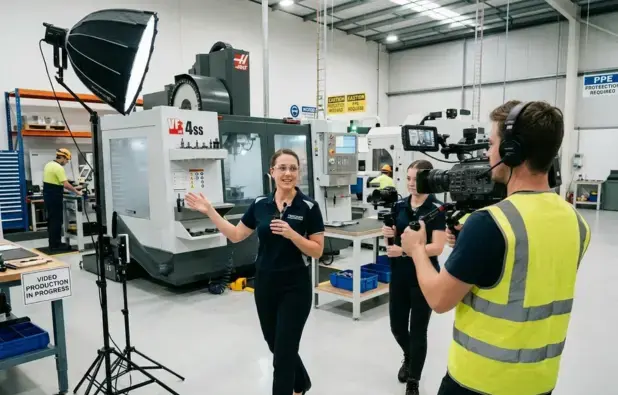
Video reduces this friction by making abstract concepts visible. A process video can show how materials move through a facility. A software walkthrough can demonstrate the steps behind a key workflow. An animated explanation can clarify a technical service without requiring the viewer to interpret a dense diagram.
Clarity is a trust signal. It tells buyers that your team understands the work well enough to explain it without hiding behind jargon. It also respects their time. A two-minute video that answers a meaningful question can move a prospect further than several paragraphs of generalized copy.
There is a trade-off to consider. A short overview video is useful early in the journey, but it should not try to explain every feature, process, or use case. Technical audiences often need deeper content later, such as product demonstrations, installation videos, FAQ videos, or role-specific training. The strongest approach builds a library of videos with different jobs rather than forcing one video to carry the entire sales conversation.
Prospects expect a company to present itself favorably. They place more weight on evidence from customers who faced similar circumstances. That is why customer story videos are among the most effective trust-building assets for organizations with a considered sales cycle.
A credible customer story goes beyond praise. It establishes the starting point, the operational or business challenge, the decision process, the work completed, and the result. Specificity is what makes it useful. A customer saying, “They were great to work with,” is positive but limited. A customer explaining that a new process reduced manual reporting, improved response times, or helped their team produce qualified leads gives the viewer something concrete to evaluate.
The best stories do not pretend every project was effortless. Buyers understand that meaningful work requires collaboration and change. When a customer explains how a partner communicated clearly, solved an unexpected issue, or kept a complex project moving, the story demonstrates reliability under real conditions.
For organizations with confidentiality constraints, a fully public case study may not be possible. In that case, consider anonymized scenario videos, industry-specific examples, or short customer quotes that have been approved for use. Imperfect proof is still more persuasive than unsupported claims, provided it remains honest.
Trust is not only about a single message. It is also about repeated, consistent exposure. When prospects see the same knowledgeable people in educational videos, service explanations, social clips, sales follow-ups, and website content, the brand becomes more familiar. Familiarity alone does not create trust, but consistent value makes the first conversation feel less like a cold introduction.
This is especially helpful for businesses with long buying cycles. A prospect might first encounter an educational video while researching a problem, return later to watch a case study, then receive a personalized video from a sales representative after requesting information. Each interaction can reinforce the same positioning: this team understands the problem, communicates clearly, and has a practical path forward.
That consistency requires coordination. Marketing may produce the core content, but sales needs to know when and how to use it. Service teams may identify common onboarding questions that deserve a video. A connected CRM and marketing automation platform can help teams understand which videos prospects watch and trigger appropriate follow-up, but the system should support useful conversations, not turn video views into aggressive outreach.
The most valuable video topics are often the ones companies avoid. Buyers want to know about pricing factors, timelines, common implementation challenges, maintenance requirements, service boundaries, and whether a solution is right for a situation like theirs. Addressing these topics directly shows confidence and helps filter out poor-fit opportunities.
A transparent video does not need to publish every proprietary detail or promise a fixed price without context. It can explain the variables that affect cost, the steps that influence project timing, and the conditions that make an engagement successful. This gives prospects a more realistic picture before they contact your team.
For example, a video about a website redesign can explain why content migration, integrations, internal approval cycles, and analytics requirements affect the timeline. A manufacturing video can show how production volume, material characteristics, and facility constraints shape equipment recommendations. These explanations make the buyer more prepared and make the sales conversation more productive.
Views are useful, but they are not the full measure of whether video is building trust. The more meaningful question is whether viewers take a next step that indicates growing confidence. That might include spending more time on a service page, returning to the website, requesting a consultation, sharing a video internally, or entering a sales conversation with more informed questions.
Track performance in the context of the buyer journey. Compare conversion paths for visitors who watch key videos against those who do not. Review which topics sales representatives use most often and where prospects continue to get stuck. Ask sales and customer service teams whether videos are reducing repetitive questions or improving expectations before onboarding.
Qualitative feedback matters, too. If prospects say, “I watched your video about this before our call,” that is evidence that the content is doing more than generating impressions. It is helping the relationship start with context.
The opportunity is not simply to produce more video. It is to create evidence that makes the next decision feel safer. Start with one question your buyers repeatedly ask when the stakes are highest, then answer it on camera with the clarity and candor your team would bring to a real conversation.
Too many companies invest in video production and end up with a polished file that never gets put to work: no distribution plan, no connection to the sales process, no way to know if it's actually building trust. A video only earns its return when it's built into a larger strategy from the start.
That's where Inbound 281 comes in. Through our in-house production studio and our broader video marketing services, we help B2B teams identify the questions their buyers are actually asking, produce the videos that answer them, and integrate that content across your website, sales follow-up, and HubSpot workflows.
If you're ready to turn video into a real trust-building system instead of a one-off project, schedule a video strategy meeting with our team, and we'll help you map out where to start.

 David Lash : June 19, 2026, 9:21:41 AM EDT
Video marketing for manufacturers works best when each video has a clear job in the buyer journey. Here are 7 video types to turn views into leads.
 David Lash : May 14, 2026, 10:01:27 AM EDT
Learn how to measure marketing video production impact on inbound KPIs. Explore attribution models, key metrics, and reporting templates built for...
 David Lash : July 9, 2026, 8:37:00 AM EDT
Discover how video marketing for manufacturers can transform your strategy in 2026. Learn to create engaging content that builds trust and drives...