B2B manufacturing buyers don't watch videos for entertainment; they watch them to de-risk a decision. A plant manager evaluating new equipment, a procurement lead vetting a contract manufacturer, or an engineer specifying a part all want the same thing: proof that you can do what you say you can do, before they ever pick up the phone.
That's why video marketing for manufacturers has become one of the highest-leverage tools in the industrial marketer's toolkit; not because video is trendy, but because it answers technical and trust-based questions faster than text or images can. The challenge isn't whether to invest in video content creation. It's knowing which video types actually move a B2B buyer through the funnel, and which ones just sit on a homepage looking nice.
This guide breaks down seven video formats every manufacturer should consider, what each one is best at, and where it fits in a lead-generating content strategy.
1. Product Demonstration Videos
What it is: A product demonstration video shows a piece of equipment, machine, or product in action, running a real cycle, performing under load, or completing the process a buyer cares about. It’s less about polish and more about proof: the buyer needs to see the thing work the way it’s supposed to.
Why it generates leads: Product demonstration videos are one of the most requested formats among industrial buyers researching a purchase, because they answer the practical question text can’t: does this actually do what the spec sheet claims? They shorten the evaluation stage by letting a buyer self-qualify before ever requesting a quote.
Where to use it:
-
Embedded directly on product and category pages
-
Linked in sales follow-up emails after a trade show or RFQ request
-
Repurposed into shorter clips for LinkedIn and YouTube Shorts
2. Customer Testimonial and Case Study Videos
What it is: A short video where an existing customer, ideally someone in a similar role to your target buyer, talks about the problem they had, why they chose you, and the result they got.
Why it generates leads: Manufacturing sales cycles are long and relationship-driven, which makes third-party proof more persuasive than self-promotion. A testimonial from a peer in the same industry does what no amount of brochure copy can: it answers the unspoken question, " Can I trust this company with my production line, my timeline, my budget?” These videos are especially effective at the decision stage, when a buyer is comparing a shortlist of vendors.
Where to use it:
-
On dedicated case studies or a “Why Us” page
-
In late-stage sales enablement materials and proposal decks
-
As social proof on LinkedIn, tagged with the customer’s industry
3. Explainer (“How It Works”) Videos
What it is: A simplified, often animated or screen-recorded video that breaks down a complex process, capability, or technology in plain language; think of it as the video version of an FAQ answer.
Why it generates leads: Many manufacturing buyers start their research without fully understanding the technical category they’re shopping in. Explainer videos meet them at the awareness stage, building familiarity and trust before they’re ready to evaluate specific vendors. This format also performs well in AI-powered search and “what is” style queries, since it’s built to directly answer a defined question.
Where to use it:
-
Top-of-funnel blog posts and pillar pages
-
Paid social campaigns targeting early-stage researchers
-
Embedded in email nurture sequences for top-of-funnel leads
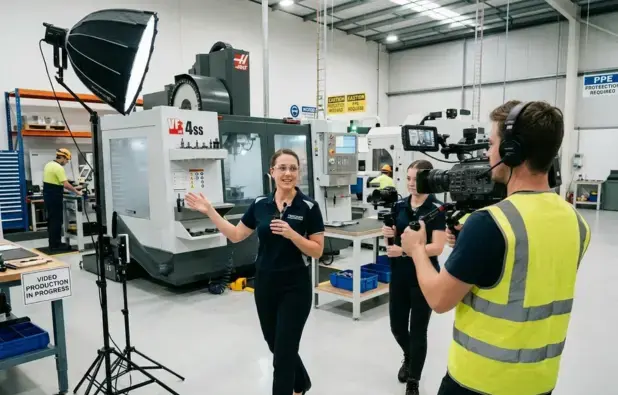
4. Facility and Behind-the-Scenes Tour Videos
What it is: A video walkthrough of your plant production floor, or quality control process, showing the scale, equipment, and people behind the operation.
Why it generates leads: For B2B manufacturing buyers, capability and capacity are often bigger questions than price. A facility tour video answers things a buyer is hesitant to ask outright: Is this company big enough for our order? Do they have the certifications and equipment we need? Does their operation look organized and well-run? This format builds the kind of operational confidence that's hard to convey in industrial marketing strategies built only on written content.
Where to use it:
-
“About Us” and capabilities pages
-
Early conversations with new prospects who haven’t visited in person
-
Recruiting and supplier-vetting pages, where it does double duty
5. Trade Show and Event Recap Videos
What it is: A short recap video capturing highlights, product reveals, or booth conversations from a trade show or industry event.
Why it generates leads: Trade shows generate a short burst of attention that fades fast once the event ends. A recap video extends that visibility, re-engaging the contacts who stopped by your booth and reaching the much larger audience of buyers who attended the show but never made it to your section of the floor. It’s also a low-lift way to keep manufacturing industry content fresh between major campaigns.
Where to use it:
-
Follow-up emails sent to booth visitors and scanned leads
-
LinkedIn posts timed to the week immediately after the event
-
Embedded in a “where to find us next” page for future events
6. FAQ and Technical Q&A Videos
What it is: A video or short series where a subject matter expert answers the specific technical questions buyers raise most often: tolerances, materials, certifications, lead times, and minimum order quantities.
Why it generates leads: These videos do double duty. For prospects still researching, they remove friction before a sales conversation even starts. For prospects already in a sales conversation, they give reps something concrete to send instead of re-explaining the same answer on every call; a meaningful efficiency gain in B2B video marketing where deal cycles already stretch across months.
Where to use it:
-
Embedded directly in the FAQ and technical resource pages
-
Sent by sales reps in response to common objections
-
Repurposed into a YouTube playlist organized by topic
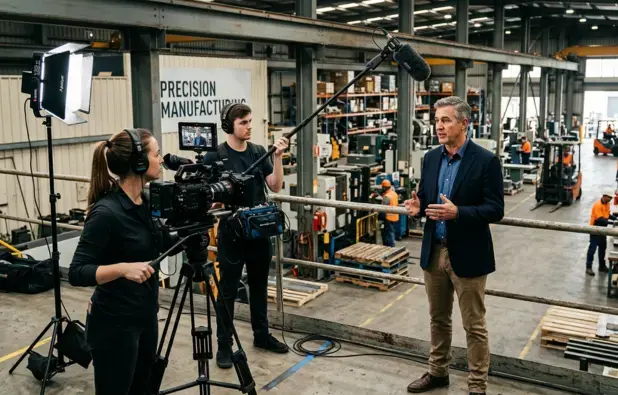
7. Founder and Leadership Story Videos
What it is: A video where a founder, owner, or senior leader shares the company’s history, values, or perspective on the industry: less product-focused, more brand-focused.
Why it generates leads: Long B2B sales cycles are ultimately relationship decisions, and buyers want to know who they'd actually be working with. A leadership story video humanizes a manufacturer in a way that spec sheets and case studies can't, building the kind of familiarity that makes a cold outreach email or a first sales call feel less cold. It's a smaller piece of the funnel, but it often tips the decision when a buyer is choosing between two technically similar vendors.
Where to use it:
-
“About Us” and leadership team pages
-
LinkedIn, especially when posted directly from the leader’s personal profile
-
Investor, partnership, or acquisition conversations where trust matters as much as capability
Turning Video Into a Lead Generation System
Individually, each of these formats answers a specific question a B2B buyer has at a specific stage of their research. Together, they form a system: awareness-stage explainers draw buyers in, demonstration and facility videos build technical and operational trust, and testimonials and FAQ videos close the gap between interest and sales conversation.
The manufacturers seeing the strongest results from video content creation aren’t the ones with the highest production budgets; they’re the ones who map each video to a specific stage of the buyer journey and a specific lead-generation goal, rather than producing video for its own sake.
If you’re not sure where to start, audit your current funnel and identify which stage has the weakest video support. That’s usually where the next video should go.
Building a video strategy that actually supports lead generation takes more than a camera and a few good ideas — it takes a plan that ties each video back to your funnel. Inbound 281 helps manufacturers build full-funnel content strategies, including video, designed to attract and convert qualified B2B buyers. If you're ready to turn video into a lead generation asset instead of a one-off project, let's talk.


 David Lash
 David Lash : July 9, 2026, 8:37:00 AM EDT


 Mark Parent