
How Does Video Increase Trust With Buyers?
 Mark Parent : August 11, 2026, 9:16:59 AM EDT
How does video increase trust? See how clear, credible video helps B2B buyers evaluate your team, understand complex offers, and take the next step...

A manufacturing prospect has spent weeks comparing suppliers before they ever speak with sales. A nonprofit donor wants proof that a program creates real outcomes. A business buyer needs to understand a technical service quickly enough to bring it into an internal meeting. That is where a B2B video production guide becomes useful: not as a checklist for making prettier content, but as a framework for producing video that answers buyer questions and moves opportunities forward.
For small and mid-sized organizations, video can be one of the most effective ways to clarify a complex offering, establish credibility, and give sales teams better tools. It can also become an expensive exercise in vague messaging if the work begins with cameras instead of strategy. The difference is a production process connected to the buyer journey, your website, your sales process, and your reporting.
A request for a brand video, customer testimonial, or product demo is often valid, but format alone does not define the job. Start by identifying the business problem the video must help solve:
Are qualified prospects leaving the website without requesting a consultation?
Does the sales team repeatedly explain the same process?
Are buyers hesitant because they do not understand your capabilities?
Is a new service difficult to introduce without lengthy presentations?
Each problem calls for a different kind of story and a different measure of success. A homepage overview video may be designed to increase time on page and encourage contact-form submissions. A technical process video may reduce friction for prospects who need to evaluate how your operation works. A customer story may give a sales representative credible proof at the moment a buyer needs reassurance.
This is also where marketing, sales, and service should compare notes. Marketing can identify common search questions and conversion gaps. Sales can share objections that stall deals. Service teams can surface the questions customers ask after they sign. The strongest video strategy does not treat those insights as separate. It turns them into a connected content plan.
B2B buyers are rarely one person. A plant manager may care about uptime and implementation. A finance leader may focus on cost, risk, and payback. An executive sponsor may want confidence that the vendor can deliver. One video cannot always carry every message equally well.
Before scripting, define who the primary viewer is, what they already know, and what they need to understand next. Then set a practical next action. That might be watching a related demo, downloading a specification sheet, scheduling a discovery call, or sharing the video with a buying committee.
A useful brief should answer a few direct questions in plain language:
What decision are we trying to support?
What confusion or concern should this video remove?
Why should the viewer believe us?
What action signals progress?
If the team cannot answer those questions, production is likely to produce a polished asset with limited commercial value.
A top-of-funnel video should earn attention by explaining a problem, trend, or perspective relevant to the audience. It does not need to deliver every detail. Its role is to make the next piece of content worth consuming.
Middle-of-funnel content needs more specificity. Explainer videos, process walkthroughs, comparison videos, and subject-matter expert interviews can show how your approach works and where it fits. For manufacturers and technical service providers, this is often the point where clear visuals make abstract claims believable.
Late-stage videos should reduce perceived risk. Customer testimonials, implementation overviews, facility tours, team introductions, and personalized sales videos can help a buyer see what working with your organization actually looks like. These assets work best when they address real concerns, not generic praise.
Strong B2B video messaging is not about fitting every capability into two minutes. It is about giving the right audience a clear, memorable explanation they can repeat internally.
Start with the tension. What is costly, slow, unpredictable, or difficult about the buyer's current situation? Then show the practical change your organization helps create. Support that change with proof: a documented result, a customer example, an expert explanation, a visible process, or a concrete differentiator.
Avoid scripts that begin with a long company history or broad claims such as "industry-leading solutions." Buyers have heard those phrases before. They need evidence that you understand the conditions they are managing. A better opening may describe the production bottleneck, reporting problem, compliance concern, or growth challenge that prompted their search.
Keep the language conversational, even when the subject is technical. Your goal is not to simplify away important details. It is to organize those details so a non-expert stakeholder can follow the logic and an expert stakeholder can see that your team understands the work.
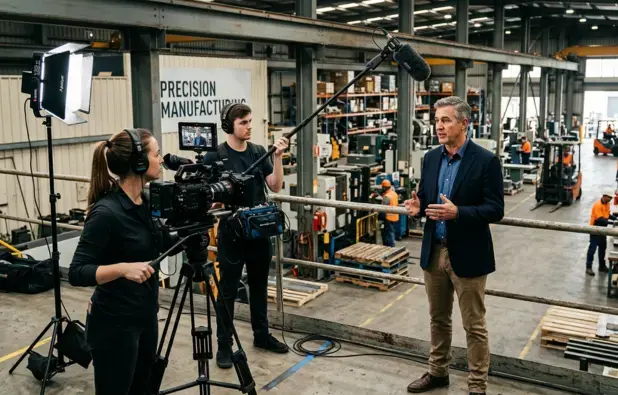
Video production requires coordination, especially when filming involves active facilities, customer sites, executives, or technical personnel. Pre-production is where most avoidable delays are prevented.
Create a production plan that identifies the purpose of each video, the required locations, featured employees or customers, key visuals, approvals, and distribution channels. If a customer story is involved, confirm permissions and expectations early. If filming in a facility, review safety requirements, confidential materials, background noise, and operational schedules before the crew arrives.
One well-planned shoot can support more than one asset. A leadership interview might produce a primary thought-leadership video, short clips for social channels, a quote for a sales presentation, and supporting content for an email nurture sequence. This approach improves efficiency, but only when the questions, footage, and edit plan are built for those uses from the beginning.
There is a trade-off. Capturing multiple assets in one day can reduce costs and make better use of subject-matter experts. Trying to capture too much can also create rushed interviews and a scattered message. Prioritize the videos tied to current revenue goals, then add secondary content only when the schedule allows.
Production quality affects trust, but quality is more than camera resolution. Clear audio, understandable pacing, accurate captions, and purposeful visuals matter because they make the information easier to absorb.
For B2B content, show the work whenever possible. If you are discussing a manufacturing process, include the equipment, quality checks, and people involved. If you are explaining a software-enabled service, show the workflow or relevant screens. If a customer describes a result, connect the statement to the situation they faced and the measurable improvement they achieved.
Captions should be standard, not an afterthought. Many business viewers watch without sound, particularly when viewing content during the workday. Captions also improve accessibility and help viewers scan technical terminology.
Length depends on the job. A concise social clip may need one clear idea in under a minute. A detailed implementation or product video may need several minutes to answer meaningful questions. Do not shorten a video simply to meet an arbitrary rule. Remove repetition, not useful context.
A finished video file does not create a pipeline on its own. Place each asset where it can help a buyer take the next step.
A high-level positioning video may belong on a core website page and in initial outreach. A customer testimonial may support a relevant industry page, a sales follow-up email, and a proposal. A technical demonstration may be valuable in a nurture workflow triggered by product interest. The same video can serve several channels, but the surrounding copy and call to action should reflect the viewer's context.
This is where a connected marketing platform becomes especially useful. When video is tied to landing pages, forms, email workflows, and contact records, teams can see more than view counts. They can identify whether viewers convert, which topics draw qualified leads, and where engaged prospects need follow-up.
Sales adoption deserves attention as well. Give representatives a clear reason to use each video and guidance on when to send it. A well-organized video library with short descriptions, intended audiences, and suggested use cases is more likely to become part of everyday selling.
Views can indicate reach, but they are not the outcome most B2B teams need. The right metrics depend on the video’s role in the journey.
For awareness content, review qualified traffic, engagement, and the rate at which visitors move to relevant pages. For conversion-focused videos, look at form submissions, meeting requests, and assisted conversions. For sales enablement assets, examine whether opportunities that receive the video progress faster, involve more stakeholders, or close at a higher rate.
Qualitative feedback matters, too. Ask salespeople whether buyers reference the video, whether it reduced repetitive explanations, and whether new objections have emerged. This feedback can improve the next script faster than a dashboard alone.
A video program should evolve with your sales conversations and customer data. At Inbound 281, that means treating video as part of a connected growth system rather than a standalone creative deliverable. The best next video is usually not the one that sounds most impressive. It is the one that answers the question currently slowing a qualified buyer down.
Are you ready to start brainstorming how video could work for you? Whether it is starting with one campaign or building a full new strategy centered around video, the Inbound 281 team can help. Talk with an advisor today to discuss goals, address gaps in your current marketing, and get clear next steps for starting with video.

 Mark Parent : August 11, 2026, 9:16:59 AM EDT
How does video increase trust? See how clear, credible video helps B2B buyers evaluate your team, understand complex offers, and take the next step...
 David Lash : June 19, 2026, 9:21:41 AM EDT
Video marketing for manufacturers works best when each video has a clear job in the buyer journey. Here are 7 video types to turn views into leads.
 Mark Parent : July 27, 2026, 9:08:24 AM EDT
Learn what makes a good explainer video: clear messaging, audience insight, purposeful visuals, and a conversion plan that supports real business...